Last updated July 9, 2026
How To Get A Carte Vitale As A Retiree In France
The Carte Vitale comes after healthcare rights, not before. For most retirees, the real sequence is legal residence, valid transition cover, CPAM affiliation, attestation de droits, social-security number, and only then the green card itself.
Who this is for
Retirees planning a move to France who need a practical healthcare guide, with extra detail for international readers.
Updated for readers
Structured as a practical planning guide with linked official sources and article-specific follow-up reading.
Next step
Join the FranceRetire list to get the next guide in this move-to-France series by email.
The Carte Vitale is one of the most important practical documents for healthcare in France, but it is also one of the most misunderstood.
A retiree does not enter the French system when the green card arrives. The first real milestone is healthcare rights being confirmed, usually through an attestation de droits.
The card comes after rights. The attestation de droits is usually the first real milestone.
Fast takeaways
The main points to understand before going deeper.
Point 1
A Carte Vitale is not the same thing as healthcare rights. It is the card used after your rights are active.
Point 2
For many non-working retirees, the normal path is private insurance first, then CPAM or PUMa after stable legal residence, then attestation de droits, then the card.
Point 3
Many delays come from sending the wrong route, weak civil-status documents, missing translations, or cancelling transition cover too early.
Most retirees get a Carte Vitale only after they first obtain French healthcare rights. For many inactive non-EU retirees, that means private insurance for the move and first months, then a CPAM file through PUMa after stable and legal residence. For some British retirees the route is S1 registration, and for some Quebec retirees it is the specific RAMQ agreement route.
For many inactive residents, Service-Public currently states that residence-based healthcare rights open only after three months of stable and legal residence. That does not mean the card arrives on day 91. It means the affiliation process can begin once the conditions are truly met.
Sources
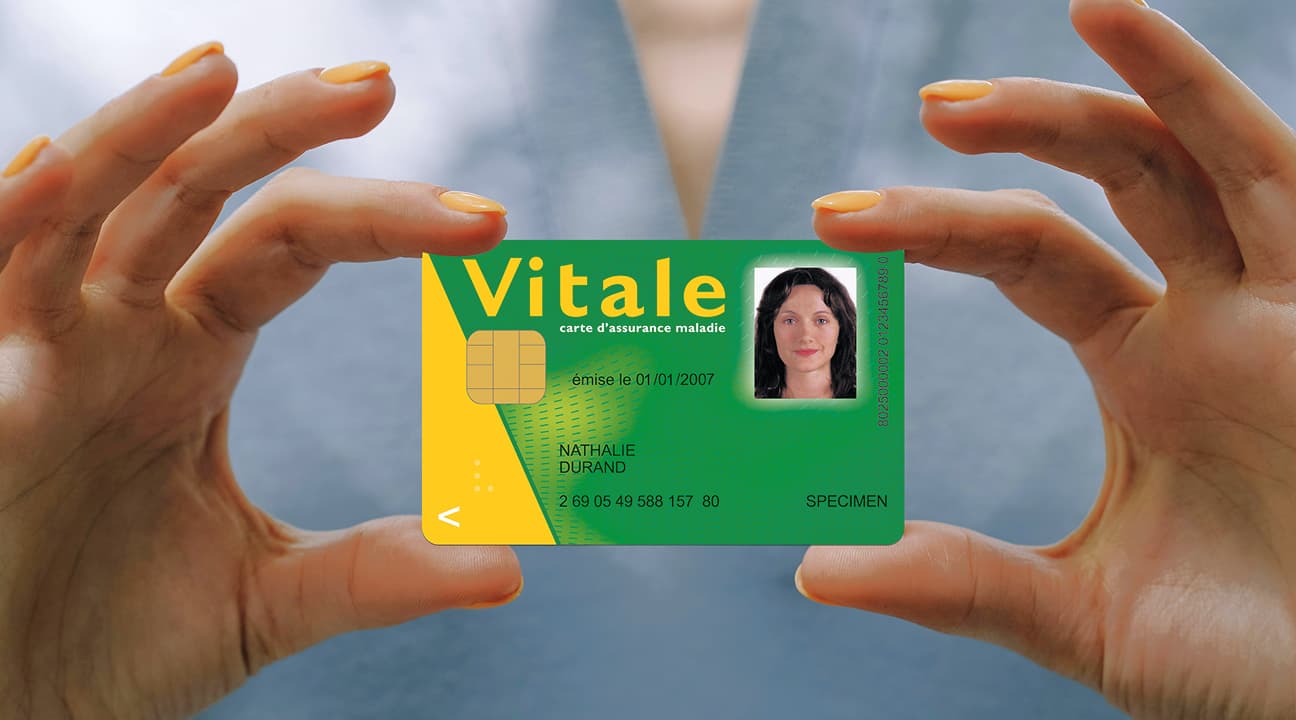
The Carte Vitale is the French health-insurance card used by doctors, pharmacies, laboratories, hospitals, and other providers to transmit treatment information electronically for reimbursement.
It is not a payment card, not proof that treatment is free, not travel insurance, not proof of immigration status, and not a substitute for private insurance before your French rights actually open.
Used to transmit reimbursement information
Usually arrives after rights are confirmed
Does not remove all patient costs
Does not replace a mutuelle or travel cover
You can have active French health-insurance rights before the physical Carte Vitale arrives. The key document is usually the attestation de droits, which proves that your rights are active in the system.
During the waiting period, that attestation often matters far more than the plastic card. Providers can work with it, and it confirms that the real milestone, your healthcare rights, has already been opened.
For many U.S., Canadian, Australian, and other non-EU retirees without a special agreement route, the common path is private insurance first and then residence-based affiliation through PUMa after stable and legal residence is established.
Do not cancel private insurance the moment you become eligible to apply. Keep it active until CPAM accepts the file, the attestation de droits is issued, and you understand what is still uncovered.
Some British retirees can register a U.K.-issued S1 with CPAM, which can be the cleanest route when genuinely eligible. Early retirees without S1 usually fall back onto the same private-insurance bridge and later PUMa logic as other non-working residents.
Quebec retirees may have a separate route through RAMQ using form SE 401-Q-207. That does not remove the need for a clean CPAM file, civil-status evidence, and practical transition planning.
Sources
Before applying for a Carte Vitale, work out which route actually applies: residence-based PUMa, S1, Quebec coordination, another international route, EU coordination, or a work-based or family-based path.
A complete file sent under the wrong route can still create delays. The first practical question is not what the card looks like. It is why the person qualifies for healthcare rights in France.
A retiree applying through CPAM should prepare a clean folder with consistent identity, address, residence, and healthcare documents. Typical files include the S1106 form, passport, visa or residence proof, address proof, birth certificate showing parentage, French bank RIB, and route-specific evidence such as private insurance, an S1, or SE 401-Q-207.
Birth-certificate and naming problems are common. Names, dates, and places should match across the passport, birth certificate, marriage certificate, visa, and bank documents.
Completed S1106 form where relevant
Passport and residence or visa proof
VLS-TS validation proof where relevant
Proof of address and proof of three months of residence where needed
Birth certificate showing parentage
French bank RIB
Private insurance, S1, or Quebec form depending on the route
For many people born outside France, the CPAM process happens in stages. A temporary number can arrive first, then the attestation de droits, and only later the permanent social-security number and the Carte Vitale.
This is why transition insurance and document discipline matter. Administrative rights can be active before the card exists, and the card itself can take months.
Sources
Once rights are active and the administrative file is far enough along, the next practical steps are creating the Ameli account when possible, receiving or ordering the Carte Vitale, and declaring a medecin traitant.
Many retirees then add a mutuelle. A mutuelle supplements the public reimbursement system. It is not the same thing as the initial visa-period insurance policy and does not replace it before public rights exist.
The Carte Vitale does not mean all treatment becomes free. French healthcare reimburses according to official rules and tariffs, and the patient can still owe co-payments, deductibles, excess fees, private-room charges, or uncovered dental and optical costs.
That is why the real planning question is broader than obtaining the green card. It is understanding the public system, the medecin traitant pathway, and whether a mutuelle makes sense for your actual needs.
The most common delays come from weak civil-status files, inconsistent names, missing translations, route confusion, or expecting the card to arrive before the rights have really been opened.
The most common planning mistake is cancelling private cover too early and assuming the three-month date or the idea of being in France automatically means the French system is already operational.
Confusing the attestation de droits with the card
Sending the wrong route to CPAM
Using weak or incomplete birth-certificate records
Cancelling private insurance too early
Assuming one spouse's file permanently covers the other adult
Thinking the Carte Vitale means all care is free
The smartest way to think about the Carte Vitale is as a late administrative step, not the beginning of healthcare rights. If you focus first on the correct legal route, a clean CPAM file, and continuous cover, the card becomes much less mysterious.
Most retiree frustration comes from chasing the green card too early instead of building the rights file properly. Rights, attestation, number, card, that is the order that matters.
Further reading